Blog
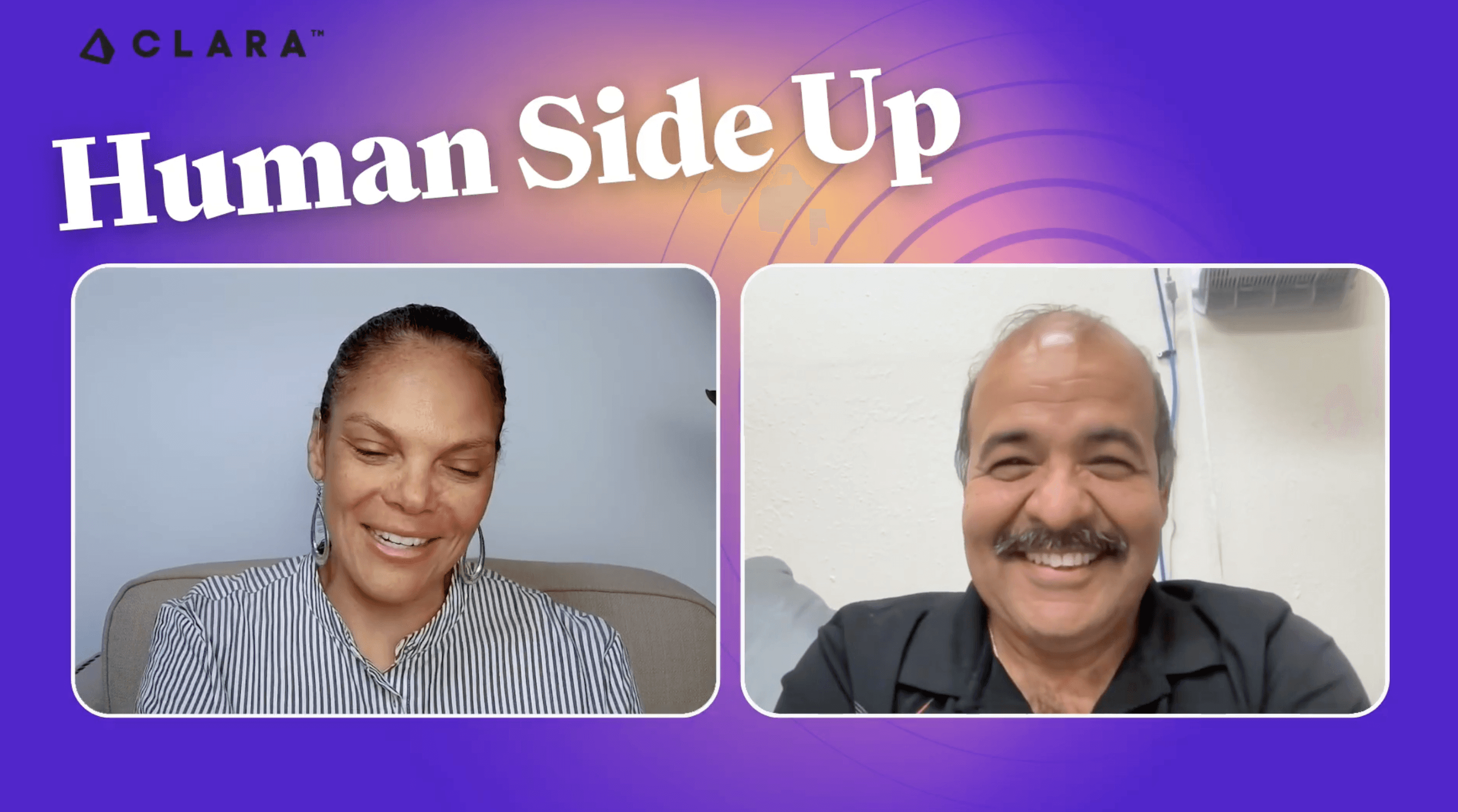
Ajay Malik is the CEO of Studio X AI, an engineer with more than 100 patents, and a lifelong builder whose career has spanned Google, Cisco, Motorola, and three startups. Known for designing systems that work invisibly in the background so humans can do their highest-value work, Malik brings curiosity, humility, and a deep love of learning to everything he does. His career has been shaped by serendipity, great bosses, and an almost joyful obsession with mastering new tools, from advanced AI platforms to Adobe Illustrator just for fun.
He joined Human Side Up podcast alongside CLARA Founder & CEO Natasha Nuytten to talk about the future of human–AI collaboration, why mentorship shaped every chapter of his leadership, and how AI can become a catalyst for creativity, compassion, and better ways of working.
A career built on chance, mentors, and gratitude
Ajay’s path into engineering began with a simple piece of advice given to his father: computer science would be a good field. “My career is so random,” he says. “The bosses you get, the companies you work in — all random.”
But that randomness is woven with something else: extraordinary managers who shaped the way he leads today. He speaks with reverence as he lists them, from his first boss in India, to his leaders at Motorola, Cisco, and Google.
“I learned so much about caring for people, about how you should treat them, how they react to things. They were all better humans.”
One manager taught him how to slow down before making a decision: take 24 hours so others feel heard. Another helped him reframe disappointment into excellence when he lost a major project. “He said, do the project you have at 160%. It clicked for me.”
These lessons, big and small, form the backbone of Ajay’s leadership philosophy: humility, gratitude, and the belief that people rise when someone sees greatness in them.
AI as a teacher and a mirror
Much of Ajay’s work centers on building AI systems that are invisible but transformative. What surprises him most is not what AI does, but what AI teaches him about himself.
He lights up as he describes it: “I burst into laughter sitting alone because I am interacting with AI and it is doing something so incredible.”
But AI has also made him more reflective about how he treats people. When he interacts with AI, he is patient, forgiving, willing to reset and try again. “When I’m dealing with AI, if it doesn’t do well, I just start a new conversation. But when I’m dealing with people, I am not like that.”
The experience has become a kind of mirror, showing him where he can lead more gently, listen more fully, and extend more grace to the humans around him.
Why AI won’t replace us
Ajay is refreshingly honest about AI’s impact on jobs. Yes, he says, job loss is coming — especially for the billions without access to digital tools. But he also believes something else is happening: the sheer velocity of work will require far more human oversight, not less.
“Productivity has gone up 25 times. If we can do that much, what that means is the people we need for sales, marketing, support, testing (even if they are using AI) you need so many of them.”
His companies already operate this way. “Every individual is now a manager of one. Nobody should think AI is another engineer. AI is your engineer.”
In this world, skill is no longer the differentiator. Creativity is. Judgment is. The ability to orchestrate a “symphony” of AI agents is.
“You hang around with a bunch of smart AI agents, and I think we will become very smart.”
A philosophy of amplifying humanity
Ajay’s leadership philosophy is simple: AI should help humans do more of what makes us human: thinking, healing, feeling, creating.
He sees creativity expanding because AI removes the technical friction that keeps ideas from becoming real. He sees people empowered to operate at higher levels of abstraction. And he sees new forms of collaboration emerging between humans and machines, ones based on curiosity, speed, and agency.
As he puts it: “Skill is not the differentiator. AI has the skill. You need to figure out how to get things done.”
In a world racing forward, Ajay stands firmly in the belief that technology should lift people up, not flatten them. That the future belongs to leaders who can integrate intelligence, compassion, and possibility.
Listen to the full conversation on this episode of Human Side Up.